Legal Frameworks Governing Protests Around the World: Rights, Restrictions, and Regional Differences
Protest is one of the oldest forms of political expression. From the streets of Paris to the squares of Hong Kong, people have gathered to demand change, resist authority, and make their voices heard. But the legal ground beneath those feet varies enormously depending on where you stand — and who is in power.
This article examines how domestic and international law shapes the right to protest, what protections exist on paper, and how those protections hold up in practice.
The Right to Protest as a Fundamental Human Right
The right to peaceful protest is recognized across international law as a core human right, closely tied to freedoms of expression, association, and assembly. It is not a privilege granted by governments — it is a right that governments are obligated to protect.
This framing matters. When states treat protest as something they permit rather than something they must respect, the legal relationship between citizen and government shifts in ways that have real consequences. A government that frames protest as a gift can more easily justify taking it away.
Freedom of assembly sits alongside freedom of speech and freedom of the press in most liberal democratic constitutions. The underlying logic is consistent: a functioning democracy requires that citizens be able to organize, speak publicly, and challenge those in power without fear of arrest simply for showing up.
That said, no legal system treats protest as unlimited. Every framework — even the most protective — draws lines around time, place, and conduct. The question is not whether limits exist, but whether those limits are proportionate, non-discriminatory, and grounded in genuine public interest.
International Law and the Right to Peaceful Assembly
International law establishes the baseline standard for protest rights through two main instruments: the International Covenant on Civil and Political Rights (ICCPR) and the guidelines developed under the United Nations Human Rights Council.
The ICCPR, which entered into force in 1976 and has been ratified by over 170 countries, explicitly protects the right of peaceful assembly under Article 21. Crucially, it specifies that restrictions on this right must be necessary in a democratic society and must serve a legitimate aim — such as national security, public safety, or the protection of others' rights. Vague justifications don't satisfy this standard.
The UN Human Rights Council has reinforced these principles through the work of the Special Rapporteur on the rights to freedom of peaceful assembly and of association. Reports from this office have repeatedly flagged how governments use overly broad laws, disproportionate force, and procedural obstacles to effectively nullify rights that are nominally protected. You can review the UN's official guidance on the OHCHR website.
International law does not enforce itself. Ratifying the ICCPR does not automatically make a country compliant — it creates an obligation, not a guarantee. That gap between obligation and reality is where much of the real-world drama of protest law plays out.
How Democratic Nations Regulate Protests
Democratic governments typically regulate protests through notification or permit requirements, time-place-manner restrictions, and rules governing police response — rather than outright bans on assembly.
In the United States, the First Amendment provides among the strongest constitutional protections for protest in the world. Government cannot prohibit peaceful assembly based on the content of speech or the political views of organizers. However, local authorities can require advance notice for large demonstrations, restrict protests near certain government buildings, and set rules about sound amplification or road closures.
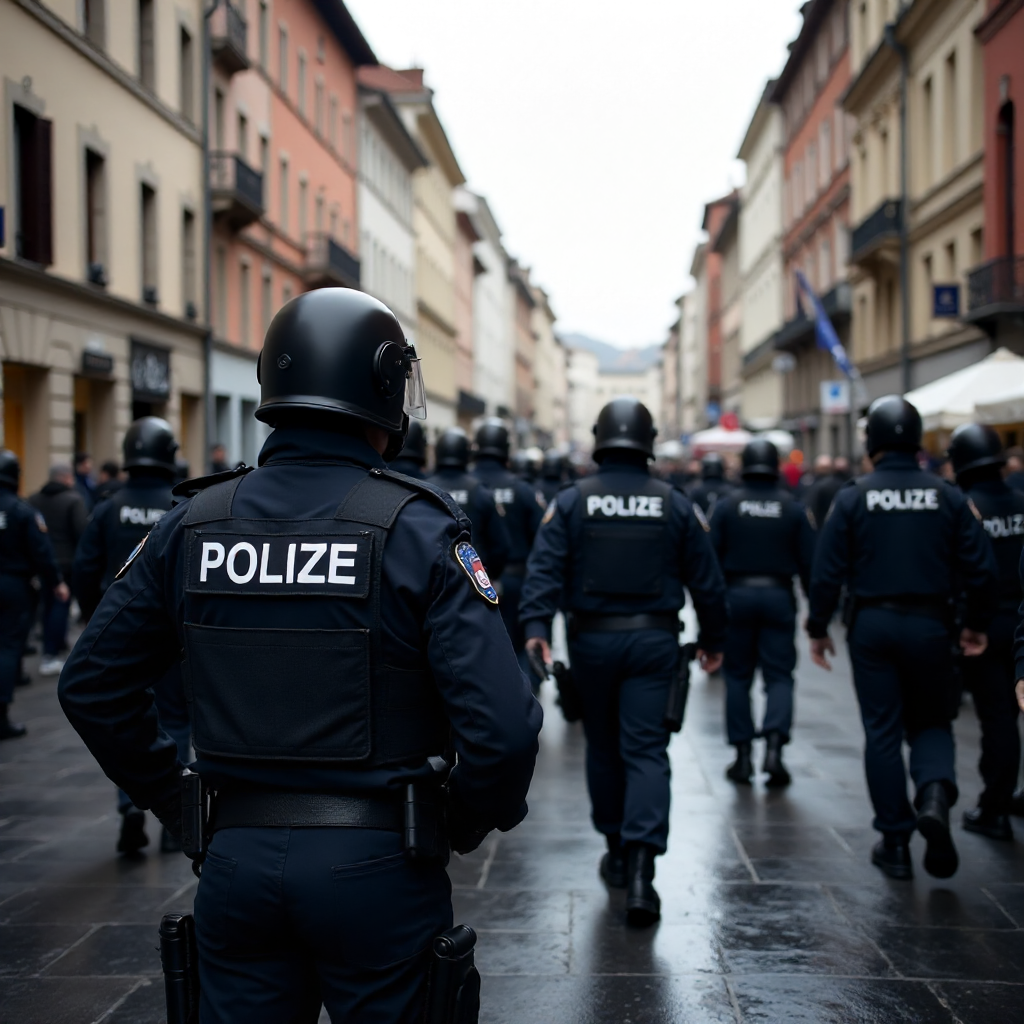
European democracies follow a broadly similar model, though with more variation. Germany requires prior notification for most public demonstrations. France has a notification system where police can prohibit a protest only if they can demonstrate a specific threat to public order. The UK's Public Order Act gives police powers to impose conditions on protests — including on route, duration, and noise levels — when they believe serious disruption is likely.
One common feature across democratic systems is the concept of designated protest zones, sometimes called "free speech zones." These areas are officially designated for demonstrations, often near government buildings or event venues. Critics argue they marginalize protest by keeping it physically distant from its intended audience. Courts in the U.S. have sometimes struck down overly restrictive free speech zones as unconstitutional.
The Role of the European Convention on Human Rights
The European Convention on Human Rights (ECHR) has been one of the most consequential legal instruments shaping protest law in Europe, largely because it comes with an enforcement mechanism: the European Court of Human Rights.
Article 11 of the ECHR protects freedom of peaceful assembly. The Court has used this provision to strike down national laws and police practices that violated protesters' rights across member states. Its rulings have established that restrictions must meet a strict test: they must be prescribed by law, necessary in a democratic society, and proportionate to the aim pursued.
The proportionality principle is particularly significant. It means that even if a government has a legitimate reason to restrict a protest — say, preventing traffic disruption — the means used must not go beyond what is necessary. Deploying riot police against a small, peaceful demonstration would fail this test. So would arresting organizers for failing to submit paperwork 48 hours in advance when no disruption occurred.
Landmark cases like Kudrevicius and Others v. Lithuania (2015) show how the Court weighs state interests against civil liberties. The Grand Chamber found that criminal convictions of farmers who blocked roads during a protest were disproportionate, reinforcing that even disruptive protest retains significant legal protection.
Protest Laws in Authoritarian and Restrictive Regimes
In authoritarian states, protest law functions differently — not as a framework for balancing rights against order, but as a tool for eliminating political opposition under a legal veneer.
Common techniques include requiring protest permits that are routinely denied, criminalizing "unauthorized assemblies" even when peaceful, and using broad anti-terrorism or national security statutes to prosecute organizers. Russia, Belarus, China, and Iran each maintain legal frameworks that nominally allow protest while making it functionally impossible to organize one without facing arrest.
What distinguishes these systems is not just the harshness of enforcement but the design of the law itself. Vague provisions about "disturbing public order" or "spreading false information" give authorities discretionary power to target dissent selectively. This is authoritarian legal restriction on assembly in its most functional form: the law appears neutral but operates as a political filter.
Even some states that are not fully authoritarian have moved in this direction. Between 2019 and 2025, several democracies passed laws that critics argue significantly expand police powers over protests — including the UK's Police, Crime, Sentencing and Courts Act 2022, which drew widespread condemnation from civil liberties organizations for its broad powers to restrict "noisy" demonstrations.
Common Legal Restrictions Governments Apply to Protests
Governments apply a range of legal restrictions to protests. Some are lawful; others cross into rights violations. The difference often comes down to specificity, proportionality, and non-discrimination.
Time, place, and manner restrictions are the most widely accepted form of protest regulation. A city can require that amplified sound stop at 10 PM in a residential area. It can prohibit marches on highways during rush hour. These rules are legally defensible as long as they apply equally to all groups and don't target specific viewpoints.
Dispersal orders become legally problematic when they are issued preemptively — before any actual disruption occurs — or when they are used selectively against particular political groups. Courts in multiple countries have found that ordering a crowd to disperse simply because police find the message objectionable violates assembly rights.
Protest bans are the most extreme restriction and face the highest legal bar. Blanket bans on all demonstrations in a city or region are rarely upheld by independent courts unless there is an extraordinary, documented threat. Even then, the ban must be time-limited and subject to judicial review.
The pattern that emerges across jurisdictions: restrictions that are specific, temporary, content-neutral, and subject to appeal tend to survive legal scrutiny. Those that are vague, indefinite, viewpoint-based, or immune from challenge tend not to — at least in systems where courts retain independence.
When Protest Law Is Used as a Political Tool
Legal frameworks on paper and legal enforcement in practice are two different things. Protest law becomes a political tool when it is applied selectively — protecting some assemblies while criminalizing others with identical conduct.
This dynamic appears in democracies as well as authoritarian states. Research on protest policing in the United States has documented significant disparities in how law enforcement responds to left-wing versus right-wing demonstrations, and how race affects the likelihood of arrest during protests. The law may be neutral; its application often is not.
Civil disobedience sits in a complicated legal space. By definition, it involves intentionally breaking a law to make a political point — blocking a road, occupying a building, refusing to disperse. Practitioners of civil disobedience typically accept arrest as part of the act. What legal frameworks rarely account for is the moral and political legitimacy that civil disobedience has historically carried, even when it is technically unlawful.
The tension is real: a state has legitimate interests in maintaining order and enforcing law. But when those interests are used to silence political opposition rather than manage genuine public safety concerns, the legal framework stops functioning as a rights-protective instrument and becomes its opposite. Recognizing that distinction — between law as protection and law as weapon — is essential for anyone trying to evaluate whether a specific protest crackdown is legitimate or not.
Frequently Asked Questions
Is it legal to protest without a permit?
In many countries, small or spontaneous protests do not require a permit. Most permit systems are designed for large, planned demonstrations. However, requirements vary significantly by jurisdiction — some cities require advance notification for any public assembly, while others only regulate demonstrations above a certain size. Failing to obtain a required permit does not automatically make a protest unlawful, but it can expose organizers to fines or dispersal orders.
Can governments ban protests for national security reasons?
Governments can restrict protests on national security grounds, but international law requires that such restrictions be specific, proportionate, and genuinely necessary. A blanket ban justified by vague security concerns would not meet the ICCPR standard. Courts in democratic countries have consistently struck down overbroad national security justifications for protest bans.
What international body can protesters appeal to if their rights are violated?
Protesters in countries that have ratified the ICCPR's Optional Protocol can file individual complaints with the UN Human Rights Committee. In Europe, the European Court of Human Rights accepts cases from individuals who have exhausted domestic legal remedies. These mechanisms are slow and have limited enforcement power, but they have produced meaningful rulings that shaped national law.
What is the difference between a peaceful protest and an unlawful assembly?
A peaceful protest involves people gathering to express views without violence or serious disruption. An unlawful assembly, in most legal systems, is one that either lacks required permits, poses an imminent threat to public safety, or turns violent. The threshold varies by jurisdiction, and the designation is sometimes applied by police before any actual disruption occurs — which is itself a contested practice under human rights law.
How does civil disobedience relate to legal protest frameworks?
Civil disobedience involves deliberately violating a law to make a political or moral point. It falls outside the protection of legal protest frameworks by definition, though participants often argue that the law being broken is itself unjust. Courts treat civil disobedience as a criminal matter while sometimes acknowledging its political context during sentencing. The distinction between civil disobedience and protected protest is not always clear-cut in practice.