Case Study: Hong Kong's Umbrella Movement — Causes, Tactics, and Legacy
In late September 2014, tens of thousands of people occupied some of Hong Kong's busiest thoroughfares, holding yellow umbrellas against police pepper spray. The images circled the globe. For 79 days, the Umbrella Movement turned a commercial metropolis into a contested political space — and exposed the deep fault lines inside the "One Country, Two Systems" arrangement that had governed the Hong Kong Special Administrative Region since 1997.
This case study examines the movement's origins, organization, and outcomes with the analytical distance the subject deserves.
Background: The Political Powder Keg
The tensions that produced the Umbrella Movement were baked into Hong Kong's constitutional framework from the start. When Britain handed the territory to China in 1997, the Basic Law — Hong Kong's mini-constitution — enshrined the "One Country, Two Systems" principle for 50 years. It preserved a separate legal system, freedom of assembly, and a degree of self-governance unavailable on the mainland.
Crucially, Article 45 of the Basic Law stated that the ultimate aim was the selection of the Chief Executive by universal suffrage. That promise kept many Hong Kongers cautiously optimistic even as Beijing's interpretation of the framework grew more restrictive through the 2000s.
By 2013, civil society had grown restless. The Occupy Central with Love and Peace movement, co-founded by legal scholar Benny Tai, proposed a campaign of deliberate, nonviolent civil disobedience in the financial district if the path to genuine universal suffrage was blocked. It was a pre-announced act of political pressure — and a signal that patience had run out.
The Spark: Beijing's August 31 Decision
The immediate trigger was a ruling by the National People's Congress Standing Committee (NPCSC) issued on August 31, 2014. The decision outlined the framework for the 2017 Chief Executive election — and it contained a structural limitation that activists found unacceptable.
While the NPCSC confirmed that Hong Kong residents could vote for the Chief Executive by popular ballot, it stipulated that all candidates first had to be approved by a pro-Beijing nominating committee. In practice, this meant Beijing retained effective veto power over who could stand for election. The demand for civil nomination — allowing the public or civic groups to put forward candidates directly — was explicitly rejected.
For the pro-democracy camp, this was not a step toward universal suffrage but a version of it that hollowed out the concept. Protest organizers moved from planning to mobilization almost immediately.
How the Movement Unfolded: Timeline and Key Events
The occupation began in earnest on the night of September 28, 2014, when police deployed pepper spray against crowds outside government headquarters in Admiralty. The move backfired. Rather than dispersing protesters, it drew enormous reinforcements. Within hours, the surrounding streets were impassable.
At its peak, the movement occupied three distinct urban sites simultaneously: Admiralty (adjacent to government offices), Mong Kok in Kowloon (a working-class commercial district), and Causeway Bay on Hong Kong Island. Mong Kok, in particular, became a flashpoint — its dense, mixed population made it politically and logistically different from the more organized Admiralty camp.
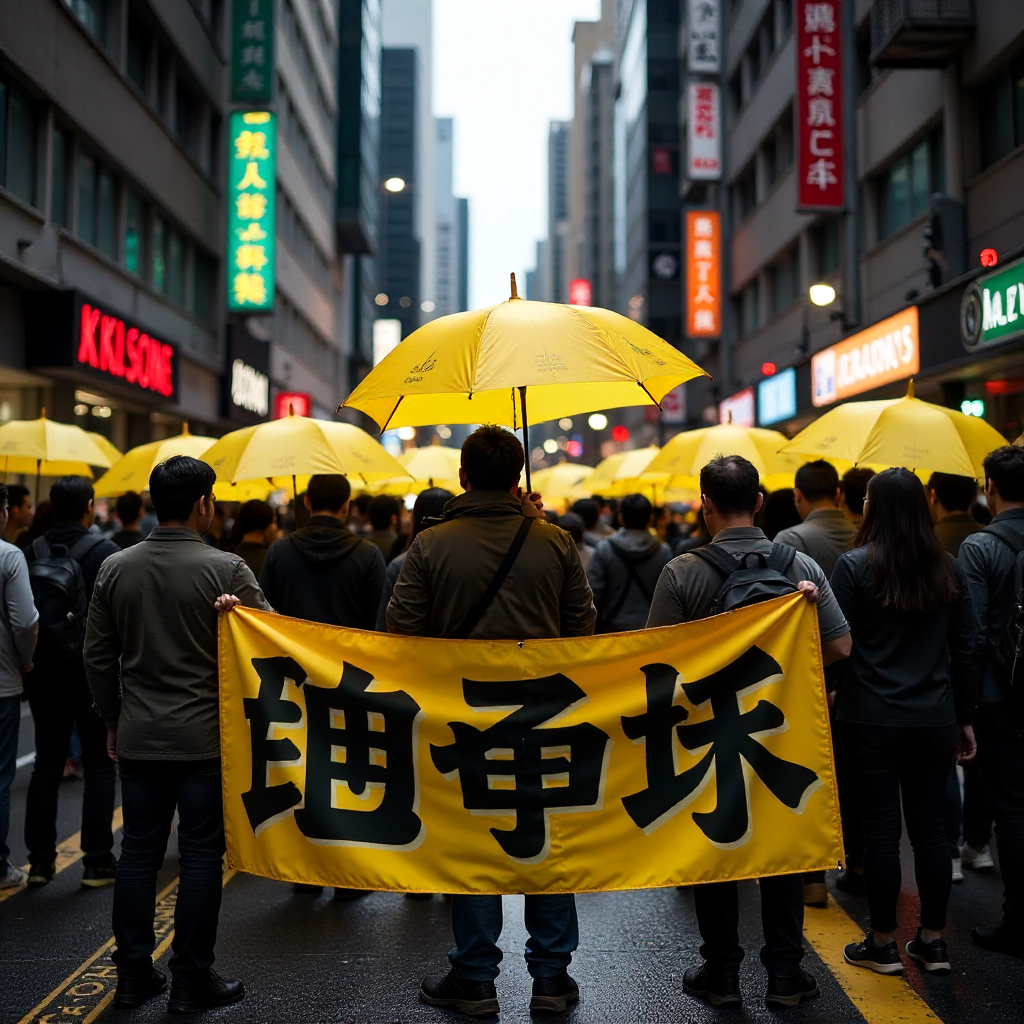
Crowd estimates varied widely depending on source and timing, but the first weekend drew some of the largest voluntary street gatherings in Hong Kong's post-handover history. Over the following weeks, numbers fluctuated. By late October, camp populations had shrunk considerably, though the infrastructure — tents, supply stations, study areas — remained in place.
The occupation ran for 79 days before the final clearances in December 2014.
Organization, Tactics, and Symbols
The Umbrella Movement had no single command structure — and that was both a strength and a liability. Occupy Central with Love and Peace had planned a disciplined, limited action. What emerged was something far larger and more diffuse, coordinated horizontally through social media platforms rather than through any unified leadership.
Protesters maintained nonviolent discipline with notable consistency. Demonstrators organized their own litter collection, first-aid stations, and supply chains. Study areas appeared under flyovers. This self-organized civic infrastructure became a point of pride and a visual counterargument to the government's framing of the occupation as disorder.
The yellow umbrella itself was accidental iconography. Umbrellas were standard rain gear repurposed to deflect pepper spray — but the image of ordinary people shielding themselves from state force made for an unusually clear visual metaphor. The symbol spread across protest movements internationally within days.
Social media coordination, particularly through Facebook and the encrypted messaging app FireChat (used when networks were congested), allowed rapid information sharing without a central node that authorities could target. The model anticipated protest communication strategies that would reappear globally in subsequent years.
Government Response and Why the Movement Ended
The Hong Kong government and Beijing made no substantive concessions during the 79-day occupation. Official messaging consistently framed the protests as illegal and destabilizing, and the Chief Executive's office declined to engage meaningfully with protest demands.
Clearances were carried out through court injunctions obtained by private businesses and transport operators affected by the blockades, rather than by direct government order — a legally cleaner approach that allowed authorities to present the clearances as a civil rather than political matter.
The movement also faced internal exhaustion. As weeks passed without political progress, divisions emerged between those who wanted to escalate and those who felt prolonging the occupation was alienating potential sympathizers. Public support among Hong Kongers not already committed to the cause eroded gradually, particularly over the disruption to commuter routes in Mong Kok.
Benny Tai and other OCLP co-founders eventually surrendered to police voluntarily, framing it as an act of moral accountability. The last camps were cleared by December 15, 2014.
What the Movement Achieved and Where It Fell Short
Measured against its stated goal — genuine universal suffrage with open candidate nomination — the Umbrella Movement failed. The NPCSC framework was not revised. The 2017 Chief Executive election proceeded under the restricted committee system. No significant political concession was extracted from Beijing or the Hong Kong administration.
That is the honest bottom line, and any analysis that obscures it is doing the reader a disservice.
But structural political change is rarely the only thing a protest movement produces. Several outcomes proved durable:
- Civic identity: A generation of Hong Kongers, many of them students during the occupation, developed a sharper sense of political identity — distinct from both mainland Chinese nationalism and pre-handover colonial identity.
- Activist networks: The movement created organizational experience and interpersonal connections that persisted long after the camps were cleared.
- International visibility: The Umbrella Movement put Hong Kong's democratic deficit on the agenda of foreign governments and media organizations in a way that earlier, smaller protests had not.
- Electoral engagement: District council and Legislative Council elections in subsequent years saw increased turnout and stronger performance by pro-democracy candidates.
The limits were real too. The leaderless structure that helped the movement grow made strategic negotiation nearly impossible. With no single interlocutor, the government had no one to talk to — even if it had wanted to.
Legacy: From 2014 to 2019 and Beyond
The Umbrella Movement did not end Hong Kong's protest era — it opened one. The networks, the political consciousness, and the unresolved grievances carried forward directly into subsequent years.
The 2019 anti-extradition protests drew on the organizational experience of 2014 activists while consciously adapting its tactics. Where the Umbrella Movement had fixed camps, 2019 used mobile, decentralized demonstrations. The 2019 protests were larger, longer, and considerably more confrontational — a trajectory that reflected in part the frustration that nonviolent occupation in 2014 had produced no structural result. You can find a detailed overview of Hong Kong's political development at the Wikipedia entry on the Umbrella Movement, which documents the sequence of events and key figures in detail.
The government's response to 2019 ultimately included the passage of the National Security Law in June 2020, which fundamentally altered the legal environment for political dissent in Hong Kong. Many activists prominent in both the 2014 and 2019 movements, including Benny Tai, were subsequently prosecuted.
Looking at the arc from 2014 to the present, the Umbrella Movement occupies a specific historical position: the last large-scale Hong Kong protest that operated entirely within the existing legal framework, that explicitly embraced nonviolent civil disobedience as a principled stance, and that still believed structural reform was achievable through pressure. Whether that belief was naive or simply overtaken by events is a question political historians will debate for some time.
Frequently Asked Questions
What was the main demand of the Umbrella Movement?
The central demand was genuine universal suffrage for Hong Kong's Chief Executive election — specifically, the right to civil nomination, allowing candidates to stand without prior approval from a pro-Beijing committee. This demand was directly rejected by the NPCSC's August 31, 2014 ruling.
Why is it called the "Umbrella" Movement?
Protesters used umbrellas to shield themselves from police pepper spray on the night of September 28, 2014. The image of crowds sheltering under yellow umbrellas became the defining visual of the occupation and quickly spread as a protest symbol internationally.
How long did the occupation last?
The occupation ran for 79 days, from late September to December 15, 2014, across three main sites: Admiralty, Mong Kok, and Causeway Bay.
Did the Umbrella Movement succeed?
Not in its primary political objective. No democratic reforms were implemented as a result of the occupation. However, the movement strengthened civic identity, built lasting activist networks, and significantly raised international awareness of Hong Kong's democratic deficit.
How did the Umbrella Movement influence later protests in Hong Kong?
The 2019 anti-extradition protests drew directly on the organizational experience and political networks formed in 2014. The 2019 movement adapted and escalated the tactics of 2014 — partly because participants had concluded that purely nonviolent, stationary occupation was insufficient to generate political concessions.