The History and Impact of Nonviolent Resistance Movements
What Is Nonviolent Resistance?
Nonviolent resistance is a form of political action that deliberately rejects physical force while actively confronting unjust power structures. It is not passivity or acceptance — it is strategic pressure applied through strikes, boycotts, marches, and civil disobedience.
The distinction matters. Passive resistance implies withdrawal or non-cooperation without confrontation. Nonviolent direct action, by contrast, puts bodies in the street, disrupts normal operations, and forces those in power to respond publicly. The goal is to make the cost of maintaining an unjust system higher than the cost of changing it.
At its core, the strategy rests on a simple premise: political authority depends on the consent and cooperation of the governed. Withdraw that cooperation systematically, and even powerful regimes face a legitimacy crisis they cannot easily suppress their way out of.
Early Roots: From Suffragettes to Gandhi
Organized nonviolent protest as a deliberate political strategy emerged most visibly in the late 19th and early 20th centuries, with the suffragette movement and Mahatma Gandhi's campaigns in South Africa and India serving as its earliest large-scale tests.
The women's suffrage campaigns in Britain and the United States combined petition drives, public demonstrations, hunger strikes, and deliberate law-breaking to demand voting rights. Suffragettes understood that moral argument alone rarely moves entrenched power — visible, disruptive action was necessary to force the issue onto the political agenda.
Gandhi refined this into a coherent philosophy. His concept of satyagraha — roughly translated as "truth-force" or "soul-force" — framed nonviolent resistance not just as a tactic but as a moral discipline. The 1930 Salt March, in which Gandhi led a 240-mile walk to the sea to protest British salt taxes, became one of history's most effective acts of civil disobedience. It was simple, symbolic, and impossible to ignore. Tens of thousands joined. International press coverage turned a tax protest into a global indictment of colonial rule.
What Gandhi demonstrated was that mass mobilization around a concrete, visible grievance could shift the political calculus in ways that petitions and legal challenges could not.
The Civil Rights Movement and the Power of Mass Mobilization
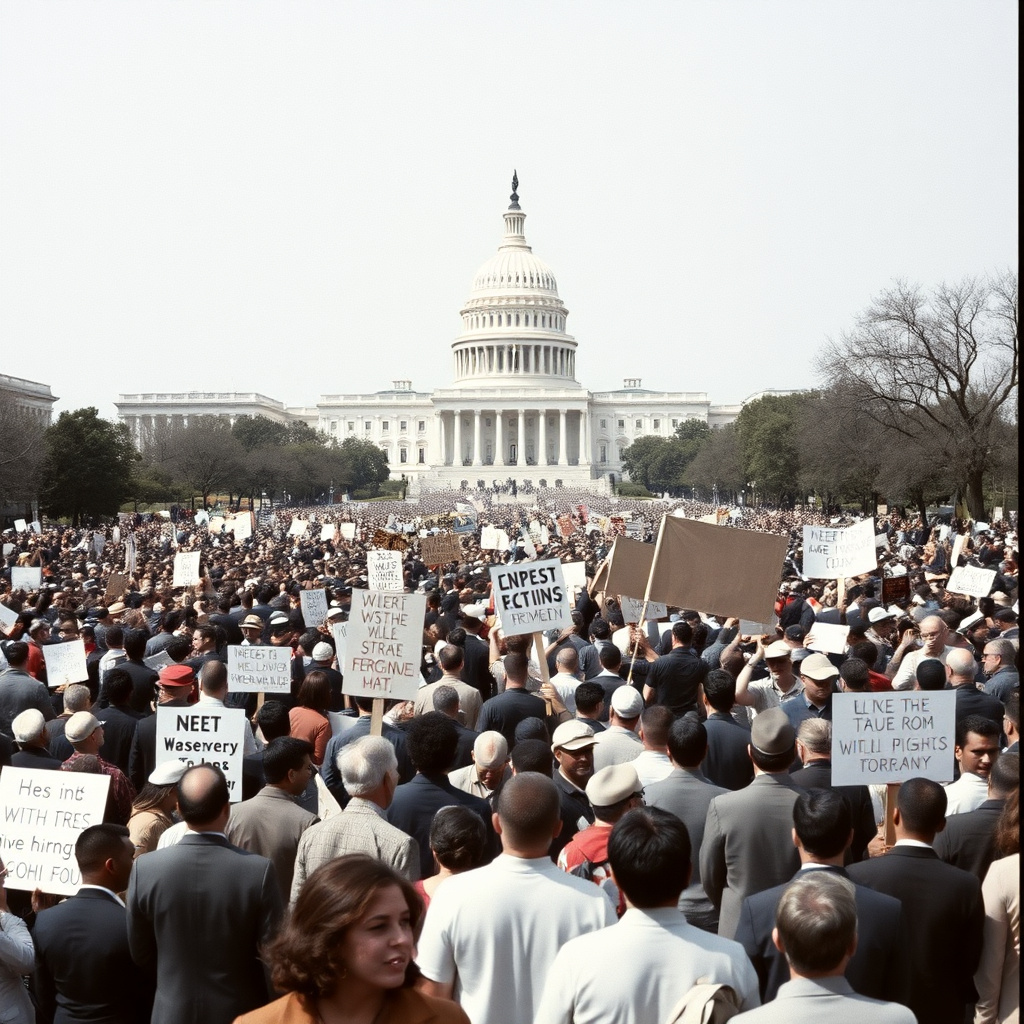
The U.S. Civil Rights Movement of the 1950s and 1960s showed that sustained, disciplined nonviolent action could simultaneously shift public opinion and force legislative change — even against a system backed by state violence.
Martin Luther King Jr. drew directly on Gandhi's framework, adapting satyagraha to the American context. The Montgomery Bus Boycott (1955–56) lasted 381 days and cost the city's transit system significant revenue. The sit-ins at Woolworth's lunch counters in Greensboro spread to dozens of cities within weeks. The 1963 Birmingham campaign, where protesters faced fire hoses and police dogs, produced images that shocked the nation and accelerated federal action.
King and the Southern Christian Leadership Conference understood something crucial: the movement's nonviolent discipline was itself a political weapon. When state authorities responded with brutality, they exposed the moral bankruptcy of the system they were defending. Television brought those images into living rooms across the country, eroding the political legitimacy of segregation in ways that legal arguments alone had failed to do for decades.
The Civil Rights Act of 1964 and the Voting Rights Act of 1965 were not inevitable. They were the product of years of organized, strategic nonviolent pressure that made the status quo politically untenable.
Nonviolent Resistance Across the Globe
The strategic logic of nonviolent resistance has proven effective across vastly different political and cultural contexts, from Eastern Europe to southern Africa.
Poland's Solidarity movement, founded in 1980 under Lech Wałęsa, organized roughly 10 million workers — nearly a third of Poland's working-age population — into a trade union that functioned as a broad-based opposition movement. Solidarity used strikes, underground publishing, and international solidarity networks to sustain pressure on the communist government through martial law and into the late 1980s. By 1989, the regime negotiated its own transition out of power.
Czechoslovakia's Velvet Revolution in November 1989 saw a communist government collapse within weeks under the pressure of mass street protests and a general strike. The speed was remarkable: what took years in Poland took days in Prague, partly because the regional political context had shifted and partly because the movement's discipline prevented the regime from justifying a violent crackdown.
South Africa's anti-apartheid struggle combined nonviolent campaigns — consumer boycotts, labor strikes, international sanctions pressure — with other forms of resistance. The African National Congress's nonviolent campaigns of the 1950s, including the Defiance Campaign, built the organizational infrastructure and moral authority that sustained the movement through decades of repression.
Why Nonviolence Works: The Strategic Logic
The most rigorous theoretical account of why nonviolent resistance works comes from political scientist Gene Sharp, whose research identified 198 distinct methods of nonviolent action and analyzed the mechanisms through which they erode authoritarian power.
Sharp's framework, developed across works including The Politics of Nonviolent Action (1973), argues that power is not monolithic — it depends on the ongoing cooperation of soldiers, bureaucrats, business owners, and ordinary citizens. Nonviolent movements work by systematically withdrawing that cooperation, creating what Sharp called "political jiu-jitsu": when a regime responds to peaceful protest with violence, it alienates the very constituencies whose support it needs.
Three mechanisms drive this process. First, conversion: some opponents genuinely change their minds when confronted with the movement's moral case and discipline. Second, accommodation: those in power calculate that concession is less costly than continued confrontation. Third, and most reliably, disintegration: the regime's own support base fractures as the costs of repression mount and legitimacy collapses.
Broad coalition-building amplifies all three. Movements that span class, religion, and ethnicity are harder to isolate, delegitimize, or suppress without triggering wider backlash. This is why the most successful nonviolent campaigns have consistently prioritized inclusion over ideological purity.
Limitations and Conditions for Success
Nonviolent resistance does not always succeed, and honest analysis requires acknowledging the conditions under which it fails.
State repression that is both total and invisible — carried out away from cameras and international observers — removes one of nonviolence's key leverage points. The Tiananmen Square protests of 1989 were met with military force and a subsequent information blackout that prevented the kind of sustained international pressure that had helped movements elsewhere. The regime paid a reputational cost, but it survived.
Internal fragmentation is another consistent vulnerability. Movements that cannot maintain strategic discipline — where factions pursue incompatible goals or tactics — give opponents opportunities to divide and discredit them. The history of protest movements is full of campaigns that had genuine public support but fractured before achieving their objectives.
Political context shapes outcomes significantly. Nonviolent resistance tends to be more effective in systems where some degree of political competition exists, where independent media can operate, or where the regime depends on international trade and diplomatic relationships. Against governments with no such vulnerabilities and no accountability to outside pressure, the calculus is harder.
Erica Chenoweth and Maria Stephan's research, published in Why Civil Resistance Works (2011), found that nonviolent campaigns succeeded roughly twice as often as violent ones between 1900 and 2006 — but "twice as often" still means a substantial failure rate. The strategy is not a guarantee; it is a set of tools whose effectiveness depends on how skillfully they are used and in what environment.
Legacy and Relevance to Contemporary Political Protests
The tactics, symbols, and strategic lessons of historical nonviolent movements continue to shape political activism in direct and traceable ways.
Contemporary protest movements draw consciously on this history. Organizers study Gene Sharp's methods. Movements adopt the visual language of earlier campaigns — the raised fist, the sit-in, the mass march — because these symbols carry accumulated meaning and signal continuity with recognized moral struggles. The Standing Rock protests, the Arab Spring uprisings, and climate activism campaigns like Extinction Rebellion have all deployed tactics with clear historical precedents.
Media dynamics have shifted dramatically since the Civil Rights era, but the underlying logic has not. Where television coverage of Birmingham in 1963 reached millions over days, smartphone footage of police responses to protests now reaches millions within hours. The mechanism — exposing the gap between a regime's self-presentation and its actual conduct — remains the same. The speed and scale have changed.
What contemporary movements sometimes underestimate is the organizational discipline that made historical campaigns effective. The Montgomery Bus Boycott required 381 days of coordinated logistics. Solidarity maintained underground networks through years of martial law. The Velvet Revolution's speed was possible because decades of slower organizing had already built the infrastructure. Visibility without organization tends to produce moments rather than movements.
The history of nonviolent resistance is ultimately a history of political strategy — of people working out, through trial and error, how to shift power without replicating its worst features. That project is unfinished, and the lessons remain genuinely useful to anyone trying to understand how political change actually happens.
Frequently Asked Questions
What is the difference between nonviolent resistance and passive resistance?
Nonviolent resistance is active and confrontational — it uses strikes, marches, boycotts, and civil disobedience to apply direct pressure on unjust systems. Passive resistance implies non-cooperation or withdrawal without active confrontation. Gandhi himself rejected the term "passive resistance" as inadequate to describe satyagraha, which required courage and active engagement rather than mere inaction.
Has nonviolent resistance ever succeeded against authoritarian regimes?
Yes, with important caveats. Poland's Solidarity movement helped bring down a communist government. The Velvet Revolution ended one-party rule in Czechoslovakia peacefully. The Philippines' People Power Revolution in 1986 ousted Ferdinand Marcos. These successes typically involved large-scale participation, some degree of international pressure, and fractures within the regime's own support base. Against regimes with total information control and no external accountability, success is considerably harder.
Who first developed the theory of nonviolent action?
Gandhi developed the first systematic practice of nonviolent resistance as a political strategy in the early 20th century. The most rigorous theoretical framework came later from Gene Sharp, whose academic work catalogued nonviolent methods and analyzed the political mechanisms through which they operate. Sharp's research has directly influenced movements from Serbia's Otpor to the Arab Spring.
What role did media coverage play in the success of nonviolent movements?
Media coverage has been central to nonviolent strategy since at least the Civil Rights Movement. When authorities respond to peaceful protest with violence, media coverage exposes that contradiction to audiences whose support the regime needs. The Birmingham campaign in 1963 was partly designed with this dynamic in mind — organizers understood that images of state violence against nonviolent protesters would shift public opinion nationally. The same logic applies today, with social media accelerating the cycle significantly.
Can nonviolent protest work without broad public support?
Broad public support is not required to start a movement, but it is generally necessary to sustain one long enough to force change. Chenoweth and Stephan's research suggests that campaigns achieving active participation from roughly 3.5% of the population have rarely failed to achieve their goals. The more important variable may be the breadth of the coalition — movements that span multiple social groups are harder to isolate and more difficult for opponents to delegitimize. A small, ideologically homogeneous group faces much steeper odds than a diverse coalition with a focused, concrete demand.